
Introduction
Starting a career in digital marketing can be tough if you have no clients or experience.
Many beginners face the same problem. They want to apply for jobs or internships, but they lack enough work to show.
This often leads to one common question:
How can I build a digital marketing portfolio without clients?
The good news is that you do not need real clients to create your first portfolio.
You can create your own digital marketing projects. These projects can show your skills to employers and potential clients.
For example, you can create a social media plan for a sample business. You can also create an SEO project, a Google Ads example, a Meta Ads example, or a blog writing sample.
You can even create a complete marketing plan for a business that you create yourself.
The important thing is to show what you can do.
You should also explain how you created each project. Tell the reader what your goal was. Explain the steps you followed. Show the final work.
This makes your portfolio more useful.
You Can Build a Portfolio Without Clients
You do not need years of experience to start.
You can begin with small projects.
For example, imagine that you want to work with a clothing brand. You can create a sample clothing brand for your portfolio.
You can then create:
- An Instagram profile
- Instagram posts
- Reel ideas
- Captions
- Hashtags
- A content calendar
- SEO keywords
- Blog ideas
- Ad examples
- A simple marketing plan
These projects can show many different skills.
You can also create projects for different types of businesses.
For example:
- Restaurant
- Café
- Salon
- Gym
- Clothing store
- Bakery
- Online store
- Local service business
Choose a business that interests you. Then, create a project around it.
Use Simple Tools
You do not need expensive software to start.
Many free or low-cost tools can help you create your portfolio.
You can use Canva to create social media posts and other designs.
You can use WordPress to create a sample website.
You can use Google tools for keyword research and basic SEO work.
You can use AI tools to find ideas, create content drafts, and plan campaigns.
Use these tools to support your work. Do not simply copy AI-generated content and add it to your portfolio.
Make changes. Add your own ideas. Check the information. Make the final work your own.
Keep Your Portfolio Honest
This is essential for beginners.
Do not say that you worked with a client if you did not.
Do not create fake results.
For example, do not write:
“I increased sales by 50%.”
If you never ran the campaign, you cannot claim this result.
Instead, write:
“This is a sample campaign created to show how I would plan a social media ad.”
This keeps your portfolio honest.
It also shows you know the difference between a sample project and real client work.
Start Small
Your first portfolio does not need 20 projects.
You can start with three or four good projects.
For example:
- Social media marketing project
- SEO project
- Google or Meta Ads sample
- Content writing sample
Explain each project clearly.
Show the work.
Explain your process.
Mention what you learned.
You can add more projects later.
Your portfolio will improve as your skills improve.
What is Digital Marketing Portfilo?

A digital marketing portfolio is a collection of your digital marketing work.
It helps you to show your skills to other people.
You can use your portfolio when you apply for:
- Digital marketing jobs
- Internships
- Freelance work
- Remote jobs
- Social media jobs
- SEO jobs
- Content writing jobs
- Marketing assistant roles
A résumé mainly tells people about your education, skills and experience.
A portfolio shows your actual work.
This is why a portfolio can be useful for beginners.
What Can You Add to a Portfolio?
You can add many types of digital marketing work.
For example:
- Social media posts
- Social media strategies
- Content calendars
- SEO projects
- Keyword research
- Blog posts
- Website projects
- Google Ads Examples
- Meta Ads Examples
- Email marketing samples
- Canva designs
- Social media audits
- Marketing plans
- Competitor research
You do not need to include everything.
Choose projects that match the type of job or work you want.
For example, if you want to become an SEO executive, add more SEO projects.
You can include:
- Keyword research
- SEO content
- Title tags
- Meta descriptions
- Internal linking ideas
- On-page SEO work
If you want to work in social media marketing, show more social media work.
You can include:
- Instagram posts
- Reels ideas
- Captions
- Hashtags
- Content calendars
- Social media strategies
- Profile audits
This helps people quickly understand your skills.
Resume vs Portfolio
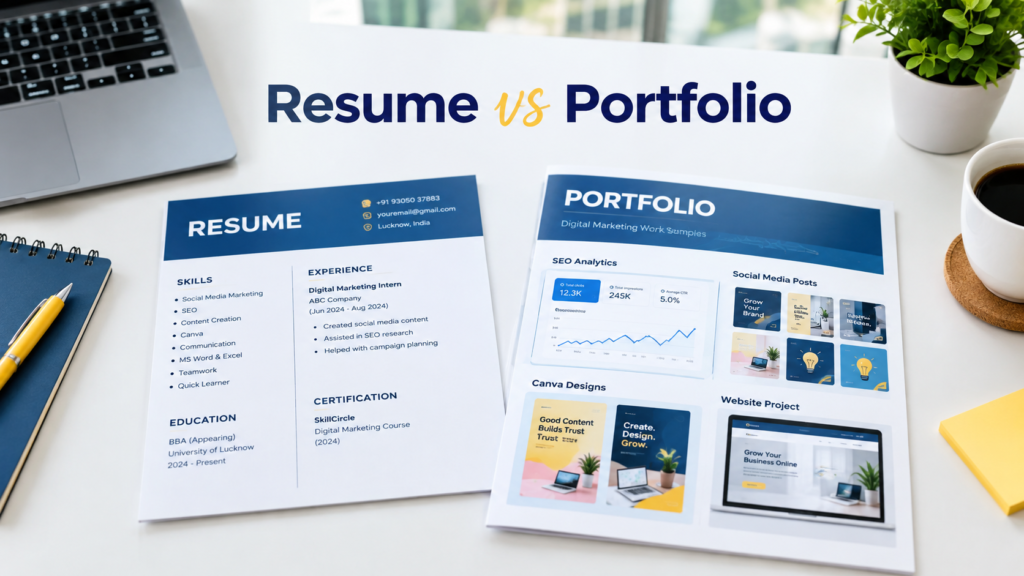
A résumé and portfolio have different purposes.
Your résumé tells people what you know.
Your portfolio shows how you use what you know.
For example, your résumé may say:
SEO
This tells the employer that you have got SEO skills.
But your portfolio can show a real example of your work.
You can show a list of keywords.
You can show a sample blog title.
You can write a meta description.
You can show how you would improve a web page.
Now the employer can see your work.
The same thing applies to social media marketing.
Your résumé may say:
Social Media Marketing
Your portfolio can show:
- Instagram posts
- Captions
- Reel ideas
- Hashtags
- Content calendar
- Posting plan
This gives people a better idea of your skills.
Explain Your Projects
Do not add pictures to your portfolio.
Explain your work.
For each project, answer four simple questions.
What was the goal?
Explain what you want to achieve.
For example:
“Goal: Increase awareness of a sample clothing brand.”
2. What did you do?
Explain the work you created.
For example:
“I created a 7-day Instagram content plan with posts, Reels, captions, and hashtags.”
3. Why did you do it?
Explain your reason.
For example:
“I shared posts to provide useful information and highlight the products.”
4. What did you learn?
Share what you have learned from the project.
For example:
“I learned how to create a simple content plan for a target audience.”
This makes your portfolio easier to understand.
Your Portfolio Does Not Need Real Clients
You can create a strong beginner portfolio without working for a real company.
You can create personal projects.
You can create sample brands.
You can create practice campaigns.
You can also audit public websites and social media profiles.
The key is to clearly label your work.
Use words like:
Sample Project
Practice Project
Personal Project
Independent Project
This tells people that you created the project to showcase your skills.
Do not present sample work as paid client work.
Keep Your Portfolio Simple
Your portfolio should be easy to read.
Do not add too much information.
Use short paragraphs.
Use clear headings.
Add images when they help to explain your work.
Show your best projects first.
Add your name and contact details.
You can also add links to your website, LinkedIn profile, or other professional pages.
Most importantly, keep improving your portfolio.
You will learn new tools and skills over time. Add your best work as you grow.
A beginner portfolio does not need to prove that you have got years of experience.
It needs to show that you can learn, create, and use digital marketing skills in real situations.
